Sew On vs Iron On Patches: Which One Should You Use?
Sewing holds longer. Ironing goes faster. Here is how to choose.
Sewing holds through heavy washing. Ironing is fast and needs no skill. Both have limits. Here is a clear verdict, then the details.
QUICK VERDICT
Iron On vs Sew On Patches: The Quick Verdict
Sewing holds longer. Ironing goes faster. Your fabric and wear decide which one wins.
| Need | Pick | Why |
|---|---|---|
| Heavy washing | Sew-on | Thread bonds through fabric |
| Speed | Iron-on | Minutes, no sewing |
| Leather or nylon | Sew-on | Heat can harm them |
| Cotton quick fix | Iron-on | Glue grips cotton fibers |
Both methods work. Each has a job it does best. The table shows where each one wins.
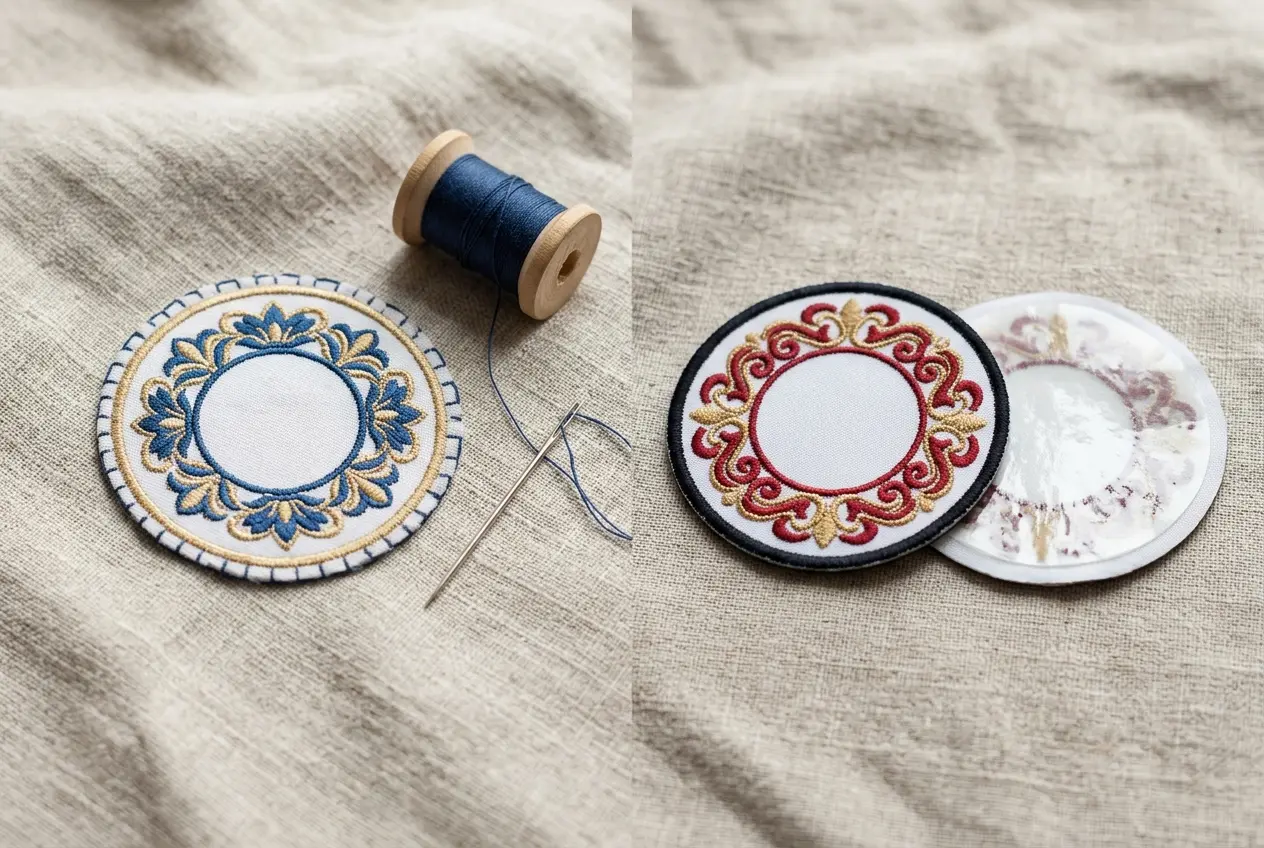
- Pick sewing for jackets, bags and work wear.
- Pick sewing for leather, nylon and wool.
- Pick ironing for cotton shirts and quick fixes.
- Pick ironing when you have no thread to hand.
SEW-ON
Sew-On Patches: Strengths, Limits and Best Uses
Sew-on patches attach with a needle and thread. Any fabric can take stitches.
Thread does the work here. Glue plays no part. That is why sewing suits so many fabrics.
Why Sew-On Holds Up Through Heavy Washing
- Thread passes through the fabric.
- Stitches hold when glue would let go.
Where Sewing Is Slower or Harder
- Hand sewing takes time and patience.
- Thick leather needs a strong needle.
Pros
- Works on any fabric
- Strongest hold for heavy wear
- Easy to repair with a few stitches
Limits
- Slower to apply
- Needs basic sewing skill
- Leaves small needle holes
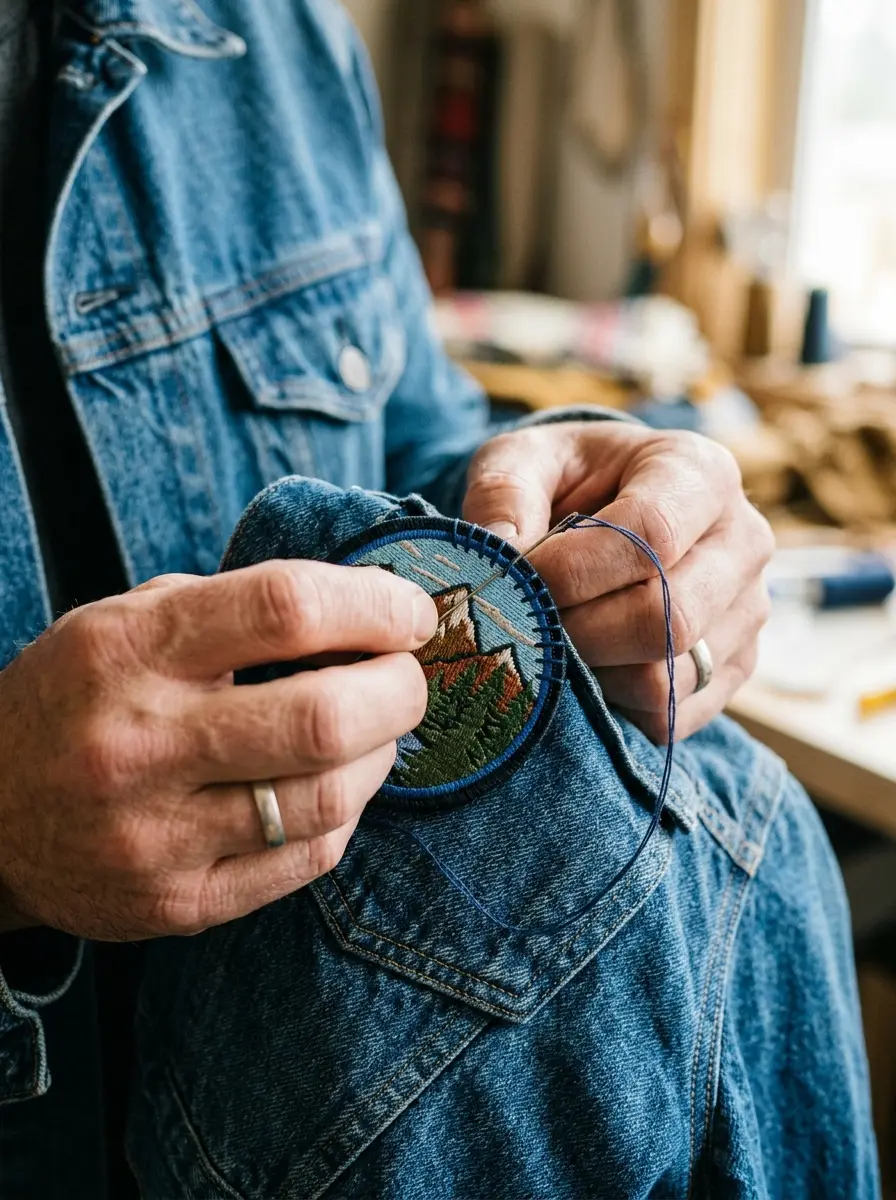
Sewing is the oldest way to attach a patch. It also lets you move or replace a patch later. Cut the thread and the patch comes free.
IRON-ON
Iron-On Patches: Strengths, Limits and Best Uses
Iron-on patches carry heat-activated adhesive. Heat melts it into the fabric.
Where Iron-On Works Best
- Cotton and denim take heat well.
- Quick fixes on shirts and bags.
Where Iron-On Fails: Nylon, Leather, Waterproof and Stretch Fabric
- Heat can melt nylon or coatings.
- Stretch fabric pulls the glue loose.
Pros
- Fast, often in minutes
- No sewing skill needed
- Neat, flat finish
Limits
- Weaker hold over many washes
- Limited to heat-safe fabric
- Edges can lift over time
Skip iron-on on anything that melts or stretches. Those fabrics need thread instead.
Iron-on patches suit people who want speed. The adhesive is on the back, so no thread is needed. Heat and pressure do the work.
- Check the fabric label before you heat.
- Use a pressing cloth to protect the face.
- Let the patch cool before you touch it.
SIDE BY SIDE
Iron On Patch vs Sew On: Side-by-Side Comparison
Eight traits separate the two. Durability figures are supplier ranges.
Read across each row. One column rarely wins every trait. Pick the traits that matter to you.
| Trait | Sew-on | Iron-on |
|---|---|---|
| Attachment | Thread through fabric | Heat-activated adhesive |
| Durability | Higher, supplier range | Lower, supplier range |
| Fabric | Almost any | Cotton, denim, some blends |
| Skill | Basic stitching | Almost none |
| Time | Slower | Minutes |
| Tools | Needle and thread | Iron and pressing cloth |
| Removal | Seam ripper | Heat, then residue cleanup |
| Cost | Thread only | Iron you likely own |
- Sewing wins on hold and fabric range.
- Ironing wins on speed and skill.
- Cost is close, since you likely own both tools.
Most people mix methods across a wardrobe. Use each where it fits best.
FABRIC AND ITEM
Which Method for Which Fabric and Item?
Iron on vs sew on patch? Check the fabric first.
| Fabric or item | Best method | Note |
|---|---|---|
| Cotton | Either | Iron-on is quick |
| Denim | Either | Stitch thick seams |
| Polyester | Sew-on | Heat can scorch |
| Wool | Sew-on | Heat can felt it |
| Nylon | Sew-on | Heat can melt it |
| Leather | Sew-on | Heat leaves marks |
| Hat | Sew-on | Curved brim |
| Bag | Sew-on | Heavy wear |
| Uniform | Sew-on | Frequent laundering |
| Kids clothes | Iron-on plus stitches | Play wear |
- Heat-safe fabric can take iron-on.
- Delicate or coated fabric needs thread.
- Heavy wear always earns stitches.
Hats, bags and uniforms take the most abuse. Use thread there. Save iron-on for light, flat cotton.
A Simple Rule for Beginners: Iron On Patches vs Sew
Thick or stretchy fabric changes the answer. Test on a scrap if you can. A hidden corner also works.
- Test on a scrap piece first.
- Check the care label for heat limits.
- Add stitches where the patch will flex.
HOW LONG THEY LAST
How Long Do Iron-On Patches Last Compared With Sewn Ones?
Suppliers quote wash counts, not promises. Treat these as supplier ranges.
Wash life depends on how well the glue bonded. Poor bonding shows up in the first few washes.
Why Iron-On Patches Fall Off
- Steam keeps the glue from setting.
- Low heat or a short press.
- A hot wash too soon.
- Nylon, leather or stretch fabric.
Care matters as much as the method. Cold washes and air drying protect the glue and the thread. Hot dryers harm both.
USE BOTH
Can You Use Both? How to Sew an Iron On Patch for Maximum Hold
Yes, you can combine them. Glue holds the patch flat while you stitch.
- Press
Fuse the patch in place.
- Cool
Let the glue set fully.
- Stitch the edge
Sew around the border.
Need full steps? Read the iron-on steps or the sewing steps.
This hybrid suits knees, bags and work gear. It costs a few extra minutes. Many people never see a lifted edge again.
TEAMS AND BULK
Iron On Patches vs Sew On for Teams, Uniforms and Bulk Orders
Teams care about speed and wash life. A heat press speeds up large batches.
Large orders bring a new question. Who applies them, and how fast? Pick the method your team can repeat.
- Stitching suits uniforms washed often.
- Iron-on suits quick, one-off team gear.
- Check your league's uniform rules.
We take bulk patch orders with no minimum, from 1 to 100,000. See bulk patch orders for details.
REMOVE AND REPAIR
Iron On Patch vs Sewing: Removal, Repair and Conversion
Plans change. Here is how each method handles removal and repair.
A sewn patch is easy to remove with a seam ripper. An iron-on patch leaves glue behind. Plan for cleanup.
| Task | Sewn | Iron-on |
|---|---|---|
| Removal | Seam ripper | Heat, then peel |
| Repair | Re-stitch the loose edge | Re-press, then stitch |
| Conversion | Fusible web adds glue | Stitch the border |
Read our removal and care guide for details.
- Re-stitch loose corners early.
- Re-press a lifting edge once.
- Replace worn patches instead of patching patches.
OTHER BACKINGS
Hook-and-Loop and Adhesive: The Other Two Backings
Two more backings exist. Both skip heat and thread.
- Hook-and-loop lets you swap patches without tools.
- Adhesive backing suits flat, light, temporary use.
See every backing option before you order.
READY TO ORDER
Pick Your Backing, Then Order It Made
Upload Artwork
Send any common file format.
Approve Your Proof
Free digital proof within 24 hours.
We Ship Worldwide
Standard 10 to 14 business days. Rush in 5.
Pick your backing, upload your art and approve a free proof.
No minimum. Free proof in 24 hours. Rush in 5 business days. Ships to 50+ countries.
COMMON QUESTIONS
Sew-On vs Iron-On Patch Questions, Answered
How long will an iron-on patch last?
Suppliers quote about 20 to 50 washes, depending on fabric and care. Those are supplier ranges, not promises. Stitching around the edge extends the life.
Do iron-on patches fall off easily?
Only when applied wrongly or on the wrong fabric. Steam, a short press and nylon are the usual causes. Correct heat and a full press hold well on cotton.
Can iron-on patches also be sewn on?
Yes. Stitch around the edge for extra hold. The glue keeps the patch flat while the thread does the heavy lifting. This is a common fix for patches on knees, bags and work gear.
Can you turn a sew-on patch into an iron-on patch?
It is possible with fusible web, which adds glue to the back. For new orders, pick an iron-on backing instead. See the backings page.
Is there a trick to iron-on patches?
Use a cloth over the patch. Skip steam. Press firmly and let it cool before moving it. The iron-on guide has every step.
What is the best stitch to sew on a patch?
A whip stitch works for most patches. Use a backstitch where you need extra strength. The sewing guide shows both.
Why sew an iron-on patch?
Stitching adds hold on knees, bags and work gear that you wash often. The thread keeps edges down when the glue starts to weaken. It is cheap insurance.
Which is better for a jacket: sewing or ironing a patch?
Sew leather, nylon and heavy-wear jackets. Use iron-on only on cotton or denim jackets. Stitch the edge either way for a longer life.
Do sewn patches survive heavy washing?
Usually better than iron-on, since thread bonds through the fabric. We make no wash-count claim. Gentle, cold washing helps every patch.
Does sewing a patch damage the fabric?
Needle holes are tiny on woven fabric and often close in the wash. On leather and coated fabric they are permanent. Plan the placement before you stitch.
Which method suits kids clothes best?
Iron-on is quick on cotton, so it suits busy parents. Add edge stitches for play wear. Kids pull, scrape and wash clothes often.
KEEP EXPLORING