Embroidered vs Woven Patches: Which to Choose and When PVC Wins
Raised thread, flat weave or molded rubber. Pick by detail and weather.
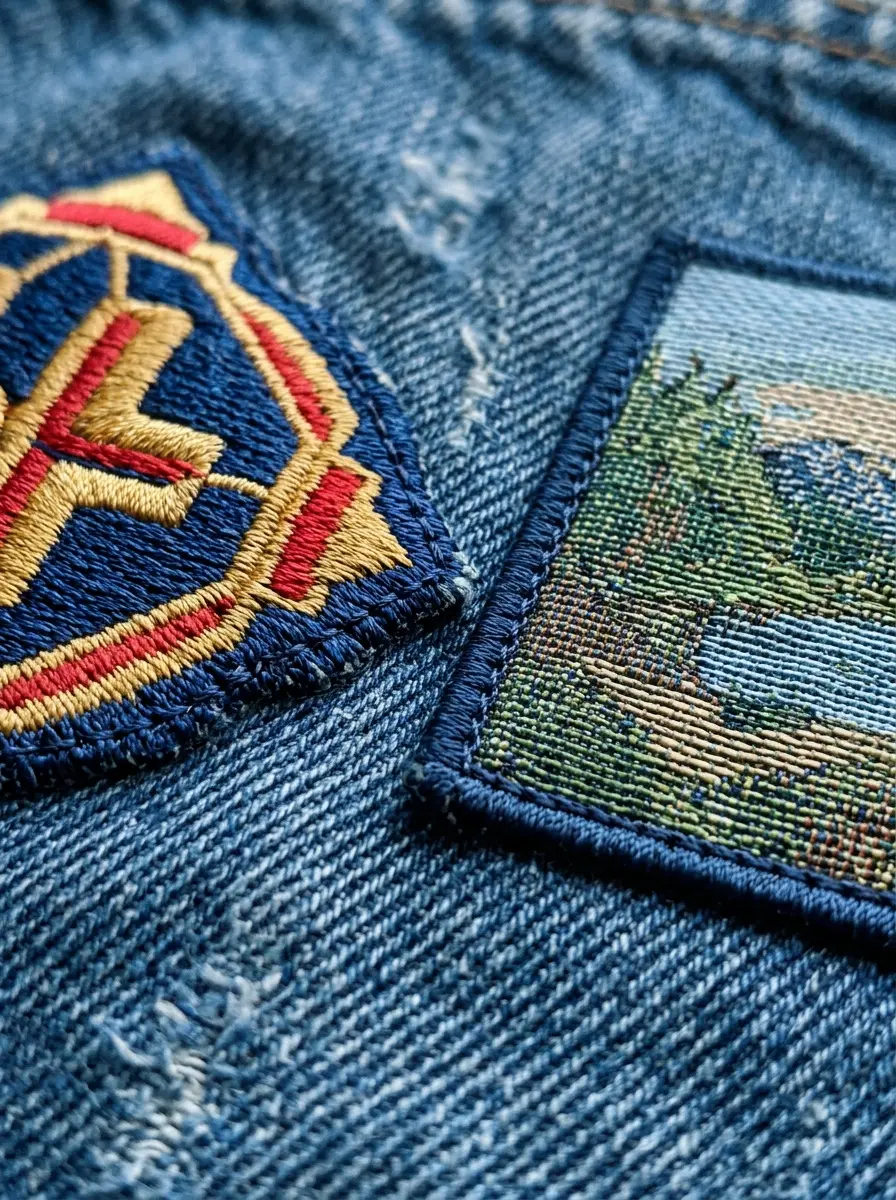
Embroidered patches are raised and bold. Woven patches are flat and fine. PVC is waterproof rubber, and chenille is fuzzy varsity texture. Here is how to pick.
THE SHORT ANSWER
Woven vs Embroidered Patches: The Short Answer
Start with detail, then weather. Those two facts pick most patches.
| Type | Look | Pick it when |
|---|---|---|
| Embroidered | Raised, textured thread | You want a bold logo |
| Woven | Flat, smooth, fine | Text or lines are small |
| PVC | Glossy molded rubber | Rain and mud are likely |
| Chenille | Fuzzy, thick yarn | You want a varsity letter |
| Printed | Photo-quality color | Art has gradients |
Embroidered and woven are the two most common types. Most buyers weigh those two first. PVC, chenille and printed fill the gaps.

- Tiny text on a small patch? Go woven.
- Big crest on a cap? Go embroidered.
- Rain, mud and sun? Go PVC.
- Photo or gradient? Go printed.
- Check your detail
Find the smallest text and thinnest line in your art.
- Check the weather
Rain, sun and rubbing point toward certain types.
- Check the fabric
Thin or stretchy fabric needs a light, flat patch.
Each type has its own page with specs and ordering. See embroidered patch details or woven patch details. This page only compares.
SIDE BY SIDE
Embroidered vs Woven Patch: Side-by-Side Comparison
Ten traits decide the choice. Read the rows that matter to your design.
| Trait | Embroidered | Woven |
|---|---|---|
| Thread | Thick polyester thread | Fine woven thread |
| Surface | Raised, textured | Flat, smooth |
| Thickness | Thicker, with stabilizer | Thinner, lighter |
| Smallest text | About 6 mm (1/4 in) | About 4 pt |
| Finest line | About 2 mm | About 0.5 mm |
| Colors | Gradients are simulated | Finer blends possible |
| Edge | Merrowed, stitched border | Merrowed or cut |
| Coverage | Twill can show through | Full woven face |
| Weight | Heavier | Lighter |
| Cost behavior | Stitch count and size | Size and weave detail |
Thickness shapes the feel. Embroidery stacks thread, so it sits proud of the fabric. Woven lies almost flat.
Thick thread cannot turn tight curves. That is why tiny letters fill in. Fine thread follows small curves cleanly.
- Thin fabric? Lean woven.
- Want texture? Lean embroidered.
- Tiny type? Lean woven.
- Bold shapes? Either type works.
Weight matters on hats and light shirts. A heavy patch can pull thin fabric. A lighter weave sits better.
HOW THEY'RE MADE
Difference Between Woven and Embroidered Patches: How Each Is Made
Both start as artwork. Each then follows a very different route.
Each route sets different limits. Knowing them saves a failed proof.
Thick Thread on Twill Against Fine Thread Woven Flat
- Digitize
Artwork becomes a stitch file.
- Stitch
Thick thread fills a twill base.
- Trim
Loose threads come off.
- Finish
A merrowed edge seals the border.
- Prepare
Artwork becomes a weave file.
- Weave
Fine threads form the design.
- Cut
The patch is cut to shape.
- Check
Edges and colors get a quality check.
Stitching suits bold shapes. Tiny details need more stitches than the space allows.
Smallest Readable Text and Finest Line on Each Type
Weaving suits detail. The threads are finer, so more lines fit in each inch.
These are supplier ranges. Treat them as a starting point. Below these sizes, details blur or fill in. Ask for a proof before you commit.
Woven vs Embroidered Patch for Small Text and Fine Logos
Thin serif fonts, fine outlines and small taglines suit weave. Thick letters and simple icons suit thread. Both can carry full-color logos.
Edges, Colour Count and Stitch Coverage
- Embroidered edges are merrowed.
- Woven edges may be merrowed or cut.
- Thread gradients are simulated blends.
- More color steps suit woven or printed.
- Coverage controls how much twill shows.
- Heavy fill makes a patch stiffer.
- Light fill lets the twill base show.
- Twill
- The fabric base under embroidery.
- Stabilizer
- A backing layer that stops puckering.
- Merrowed edge
- A tight overlock border around the patch.
- Digitizing
- Turning artwork into a stitch file.
PVC VS THREAD
PVC vs Embroidered Patches: Waterproof Rubber Against Stitched Thread
PVC is soft rubber poured into a mold. It has no thread and no fabric base.
| Trait | PVC | Embroidered |
|---|---|---|
| Material | Molded rubber | Stitched thread |
| Water | Waterproof | Water-resistant |
| Surface | Smooth, 3D | Textured, raised |
| Edge | Sealed, no fray | Edge can fray |
| Sun | Fade resistant | Thread can fade |
| Color | Flat fills | Thread colors |
| Feel | Firm, rubbery | Soft, textile |
| Cost | Usually higher | Falls with quantity |
Rubber has no weave to soak up water. That is the whole advantage. It also means no soft, fabric feel.
Each PVC design needs its own mold. Mold detail is why PVC often costs more.
What PVC Patches Are Made From and Where They Are Used
PVC wins when weather is harsh. Embroidery wins when you want a soft, textile look. Neither is best in every case.
- Outdoor and tactical gear
- Sports bags and backpacks
- Rain jackets and work wear
- Dog gear and wearables
- Brand merchandise
- Caps and boat equipment
Rubber builds detail from raised layers. Edges can be rounded or stepped. Light then catches each step.
PVC vs Silicone Patches: Two Moulded Options
| Trait | PVC | Silicone |
|---|---|---|
| Feel | Firm rubber | Softer |
| Material | Contains PVC | PVC-free |
| Process | Molded | Molded |
| Common use | Gear, bags | Wearables, dog gear |
Silicone availability varies. Ask before you plan around it.
How PVC Patches Are Attached
- Hook-and-loop backing is common.
- Adhesive backing suits flat surfaces.
- Sew-through holes can be added.
- Iron-on heat can warp PVC.
See every backing option for how each one holds.
Pick the backing by where the patch lives. Gear that changes often suits hook-and-loop. Fixed bags suit sew-through or adhesive.

CHENILLE
Chenille Patches: Where the Fuzzy Varsity Look Fits
Chenille uses thick, soft yarn on a felt base. It looks like a varsity letter.
Chenille yarn is looped, which gives the soft pile. Felt holds the shape. Thin lines and small text vanish into the pile.
- Fuzzy, thick, soft to touch
- Bold shapes and large letters
- Little room for fine detail
- Classic on letterman jackets
- Keep letters thick.
- Keep shapes simple.
- Skip tiny taglines.
Chenille often pairs with stitching. A chenille letter can carry a stitched outline.
Chenille works best at larger sizes. Fine detail gets lost in the loops. Keep letters large and shapes bold.
PRINTED
Printed Patches vs Embroidered: When Photo-Quality Colour Wins
Printed patches use dye-sublimation or digital print. Gradients and photos come out clean.
Print sits on a flat face. Color goes on as dye or ink, not thread. That is why gradients stay smooth.
Pros
- Widest color range
- Photos and gradients print well
- Fine detail stays crisp
Limits
- Lower rub resistance than stitching
- Flat, with no raised texture
- Print can wear at the edges
- Photo artwork
- Full-color mascots
- Soft gradients
- Short, detailed runs
Our printed patch page covers the process.
- Great for photo art on a small badge
- Smooth blends in sunsets and skies
The trade-off is wear. Stitched thread resists rubbing better than a printed face. Plan for that on sleeves and bags.
BEST FOR YOUR USE
Which Patch Type for Uniforms, Outdoor Gear, Fashion and Fine Text?
Match the type to the job. Use this table as a quick filter.
| Use case | Best type | Why |
|---|---|---|
| Uniforms and teams | Embroidered | Bold, familiar, durable |
| Outdoor and tactical | PVC | Waterproof, sealed edge |
| Fashion labels | Woven | Flat, fine, light |
| Photo artwork | Printed | Unlimited color |
| Varsity letters | Chenille | Thick, soft, bold |
| Hats and jackets | Embroidered | Holds shape, raised look |
Wear and detail both count. A cap front needs a tough, raised patch. A shirt label needs a thin, flat one.
Uniforms, Teams and Varsity: Embroidered or Chenille
- Embroidered suits crests and names.
- Chenille suits large varsity letters.
- Both survive repeat washing with care.
Outdoor, Tactical and Wet Conditions: PVC
- PVC sheds rain and mud.
- Hook-and-loop lets you swap it.
- Rubber edges will not fray.
Fashion Labels, Fine Text and Photo Art: Woven or Printed
- Woven patch vs embroidered: weave holds tiny text.
- Printed handles photos and gradients.
- Both sit flatter on thin fabric.
Check the fabric too. Nylon, leather and stretch knit change what works.
Raised crest on the chest, rubber tag on the sleeve.
Fine label inside, big letter outside.
Photo panel framed by a stitched border.
COST
How Cost Compares Across the Four Types
Quantity, size and stitch count decide cost. Compare an embroidered patch vs woven patch at your own numbers.
| Type | Tier | What moves it |
|---|---|---|
| Embroidered | Base tier | Stitch count, size, quantity |
| Woven | Near embroidered | Size, weave detail, quantity |
| PVC | Usually above | Mold detail, layers, size |
| Chenille | Usually above | Size, letter count |
Small runs cost more per patch. Large runs spread setup across more pieces. That holds for every type.
Complex designs cost more in any type. Embroidery adds stitches. PVC adds mold detail. Woven adds weave detail.
- More stitches raise embroidery cost.
- More layers raise PVC cost.
- Bigger sizes raise every type.
- Higher quantity lowers every type.
- Mixed sets are common, such as woven crests with PVC tags.
- Each type is a separate line on the quote.
- Keep one border color to tie a mixed set together.
Get exact numbers on the pricing page.
Ask for a quote on two types. The gap on your own artwork is the only number that counts.
DURABILITY
How Long Each Patch Type Lasts: Wash, Sun and Rain
| Type | Wash | Sun | Rain | Edge |
|---|---|---|---|---|
| Embroidered | Many washes, with care | Fades slowly | Water-resistant | Merrowed, sturdy |
| Woven | Good, with care | Fades slowly | Absorbs water | Check finish |
| PVC | Rinse or wipe | Fade resistant | Waterproof | Sealed, molded |
| Chenille | Hand wash best | Fades slowly | Absorbs water | Felt base edge |
| Printed | Lower abrasion life | Some fade risk | Absorbs water | Cut or merrowed |
Test results vary by supplier. We list general expectations, not promises. Ask about the spec for your own order.
Care changes every row. A patch washed gently lasts far longer than one tumbled hot. Sun and rubbing wear every type over time.
- Wash cold and inside out.
- Air dry, never tumble hot.
- Wipe PVC clean with a damp cloth.
Rain is the clearest split. PVC shrugs it off. Thread patches soak up water and then dry.
Our patch care guide covers washing in detail.

Storage matters more than most buyers expect. Keep spare patches flat, dry and out of direct sun. Heat can warp PVC and soften glue on iron-on backs.
READY TO ORDER
Pick a Type, Send Your Artwork, Approve a Free Proof in 24 Hours
Upload Artwork
Send any common file format.
Approve Your Proof
Free digital proof within 24 hours.
We Ship Worldwide
Standard 10 to 14 business days. Rush in 5.
Send your art in AI, EPS, PDF, PNG or JPG. Your free proof arrives in 24 hours.
No minimum. Free proof in 24 hours. Rush in 5 business days. Ships to 50+ countries.
COMMON QUESTIONS
Embroidered, Woven and PVC Patch Questions, Answered
Are woven or embroidered patches better?
Neither wins every time. Woven is better for fine text and thin lines. Embroidered is better for bold, raised logos. Pick by your artwork detail and by where the patch will be worn.
What is the difference between embroidered and woven patches in one line?
Embroidered patches stitch thick thread for a raised look. Woven patches use fine threads for a flat, detailed face.
Is woven the same as embroidered?
No. They differ in construction, thickness and detail limits. Embroidery stitches thread onto a base. Weaving builds the design from the threads themselves.
What are the key differences between PVC and embroidered patches?
PVC is molded, waterproof and 3D. Embroidered patches are stitched textile and water-resistant. PVC has a sealed edge, while stitched edges are merrowed. PVC usually costs more.
How durable are PVC patches?
Suppliers say PVC patches resist water, fading and cracking. That makes them a strong pick for outdoor gear and daily rain. Ask us about the exact spec for your design.
What are PVC patches used for?
They suit outdoor and tactical gear, sports bags, rain jackets and brand merchandise. Think of anywhere that water, mud or sun is part of daily wear.
How are PVC patches attached?
Hook-and-loop and adhesive are common, and sew-through holes can be added. See the backings page for the options. Avoid iron-on heat, which can warp rubber.
What are the differences between PVC and silicone patches?
Both are molded. Silicone is softer and PVC-free, while PVC is firmer. Availability varies by supplier, so ask us before you plan a design around silicone.
What plastic is used for embroidery patches?
None. Stitched patches use thread on a fabric base. PVC is the plastic in molded rubber patches. Those are a different type from embroidery.
What fabric can you not embroider on?
Very thin, stretchy or slick fabrics tend to pucker under stitching. A patch solves this because the stitching sits on its own separate base.
What is the difference between embroidery and patches?
Embroidery is stitched straight onto a garment. A patch is a separate piece you attach later. That means you can move it, swap it or replace it.
Which patch type feels softest against skin?
Woven patches feel smoothest because the threads lie flat. Embroidered patches feel bumpier. PVC feels like rubber. For a collar or sleeve near skin, woven is the gentlest pick.
KEEP EXPLORING