Letterman Jacket Patch Placement Guide
A zone by zone map for your letter, name, sleeves and back.
Patches sewn in the wrong spot are hard to undo. This letterman jacket patch placement guide maps every zone. Plan the layout first, then order.
ZONE MAP
Letterman Jacket Layout: Five Zones and What Belongs in Each
A letterman jacket has five patch zones. Each zone has one main job. Know the jobs and the layout stays calm.
Many guides cover where to put patches on letterman jacket panels. Few show the whole map at once. This one does. Use it as a starting plan for any letter jacket patch placement.
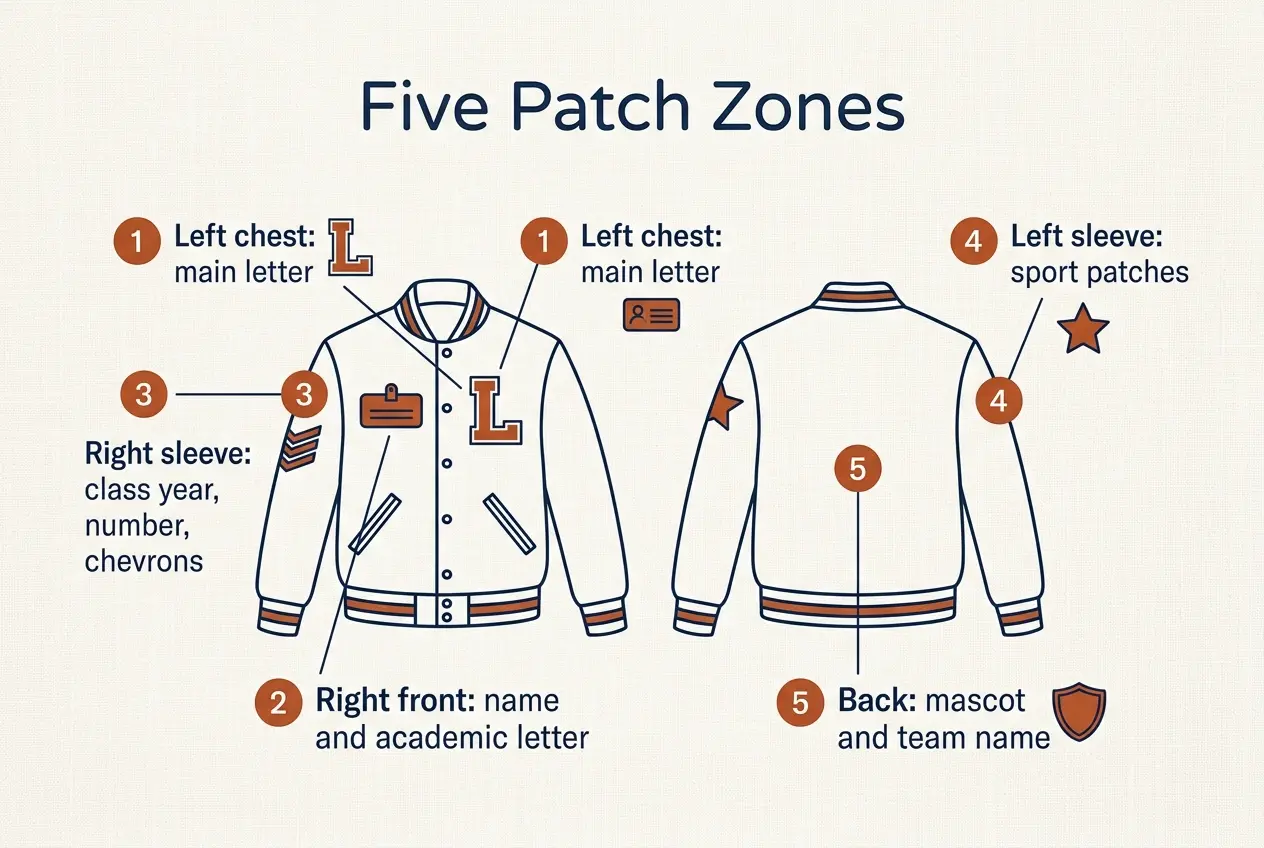
| Zone | What goes there | Weight |
|---|---|---|
| Left chest | Main school letter | Largest |
| Right front | Name, academic letter | Small |
| Right sleeve | Year, number, chevrons | Small |
| Left sleeve | Sport and activity patches | Small to medium |
| Back | Mascot, team name | Very large |
One big letter. Nothing competes with it.
Name text and the academic letter.
Year, number and a chevron stack.
Sport patches and overflow.
The mascot and team name, seen from far away.
- Left chest holds the one big letter
- The right front holds name text
- Sleeves hold small, earned marks
- The back holds the loudest design
Placement varies by school. Your jacket may also arrive with some elements already sewn on. Work around those first.
- Letter
- The main chenille award, usually school initial.
- Academic letter
- A letter for non-sport honors.
- Chevron
- A V shaped bar that counts time or status.
- Class year
- The graduation year, often two digits.
- Captain patch
- A mark for a team leader.
Zones are tradition, not law. A school can change them. Your coach or athletic office has the final word.
- Ask for a placement sheet
- Ask about chevron rules
- Ask about captain marks
- Ask where the class year goes
LEFT CHEST
Left Chest: Where the Main Letter Sits
The main letter goes on the left chest, over the heart. It is the biggest patch on the jacket. Everything else is sized around it.
Pick letters for letterman jacket use by size first. A senior varsity letter is often 6 to 8 inches tall. Junior varsity letters run smaller, near 4 to 5 inches.
- Lay the jacket flat and button the placket.
- Find the center of the left chest panel.
- Hold the letter so it sits over the heart.
- Keep a clear gap from the snap line and shoulder seam.
The letter marks the main sport or activity earned. Per Wikipedia, Harvard baseball wore the first varsity letter in 1865. It was an Old English H.
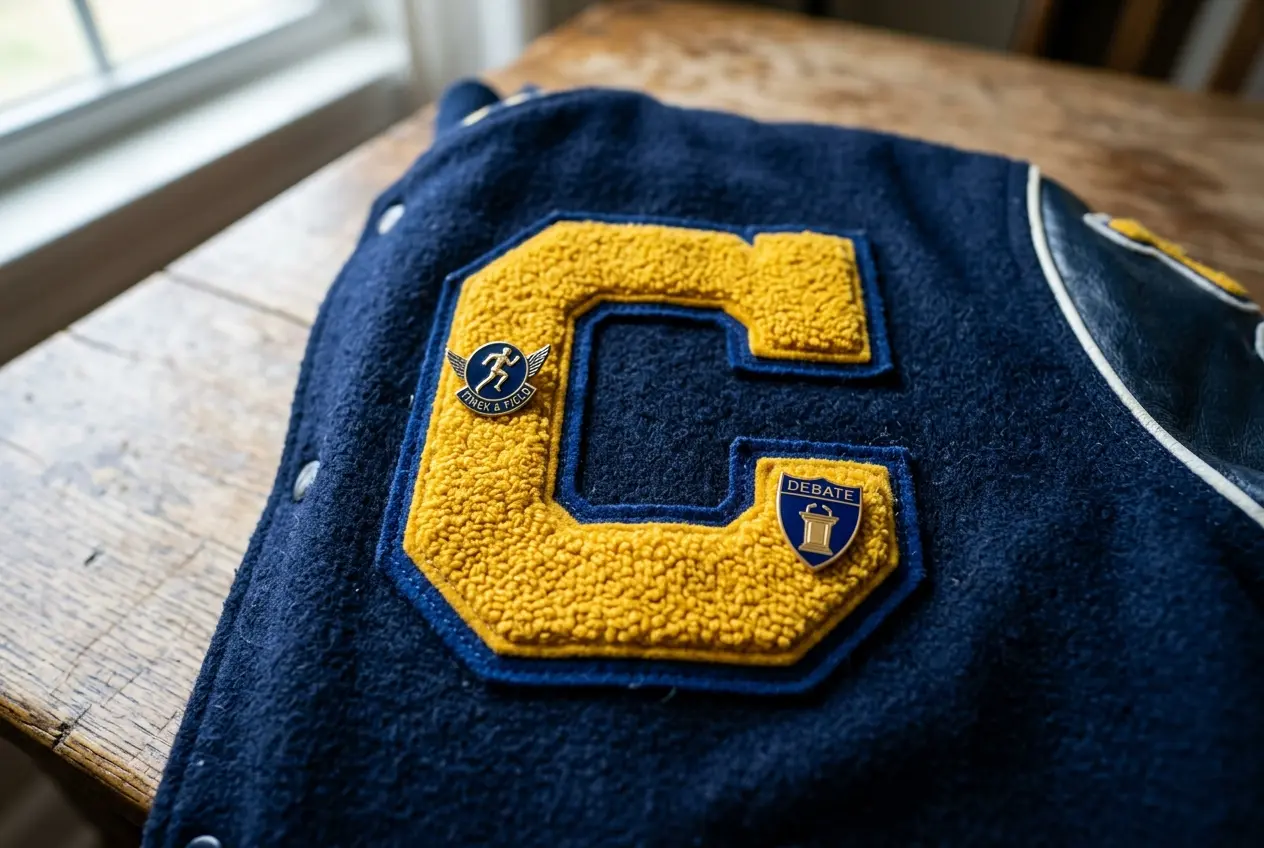
Pins and Medals Go Through the Chenille
Small activity pins often pin straight through the chenille. They sit on the letter, not beside it. This keeps the chest clear.
- Pins go through the chenille pile
- Line them up in a neat row
- Keep the row inside the letter
- Add pins after the letter is sewn
| Check | What to look for |
|---|---|
| Centered | Even space left and right |
| Level | Top edge parallel to the hem |
| Clear | Gap from snaps and seam |
| Pins | Row stays inside the letter |
Check from a few feet away. Your eye sees tilt faster than a ruler does.
Some schools also award academic letters. Those go on the right front. Keep them smaller than the sport letter.
- Press the panel if it is creased
- Pin from the center outward
- Check the wool lies flat
A heavy letter on thin cloth can sag. Wool bodies hold chenille well. Flat, smooth cloth keeps the letter square.
RIGHT FRONT
Right Front Panel: Name, Nickname and Academic Letter
The right front is the name side. Many jackets put the name or nickname across from the second snap. An academic letter often sits right below it.
Some schools place the graduation year here instead of on the sleeve. Others skip the name. Check how your school does it.
- Name
- Your first name, last name or nickname.
- Nickname
- A short name, often used on varsity jackets.
- Academic letter
- A letter for honors, placed below the name.
| Item | Usual spot | Note |
|---|---|---|
| Name or nickname | Across from second snap | Script or block text |
| Academic letter | Below the name | Smaller than the sport letter |
| Class year | Right sleeve or right chest | Varies by school |
| School emblem | Right chest | Optional |
- Keep text patches short and clear
- Match thread colors to the letter
- Align the name with the snap
- Leave a gap above the pocket line
The right side stays slightly smaller than the left. That keeps the letter in charge. Name text should never outshine it.
- Find the second snap.
- Mark the name line across from it.
- Center the name in the panel width.
- Place the academic letter just below.
| Name length | Layout |
|---|---|
| Short name | One line, larger text |
| Long name | Two lines or smaller text |
| Nickname | One short line |
Test the text length on paper. A name that runs past the panel looks cramped.
- Keep the name level with the snap
- Keep the academic letter centered below it
- Keep both clear of the pocket opening
- Keep colors in the school palette
RIGHT SLEEVE
Chevron for Letterman Jacket Sleeves: Year, Number and Stack Order
The right sleeve often carries the graduation year just under the shoulder. A jersey number can sit at the same height. Chevron bars then stack below them.
Stack order matters because each new bar needs room. Leave space at the bottom of the stack.
- Space bars evenly
- Align every bar to the same center line
- Leave a cuff gap so bars never curl
- Test the arm bent before you sew
Some guides place bars lower on the sleeve. That leaves a clean gap beneath the year. Either way works if the spacing stays even.
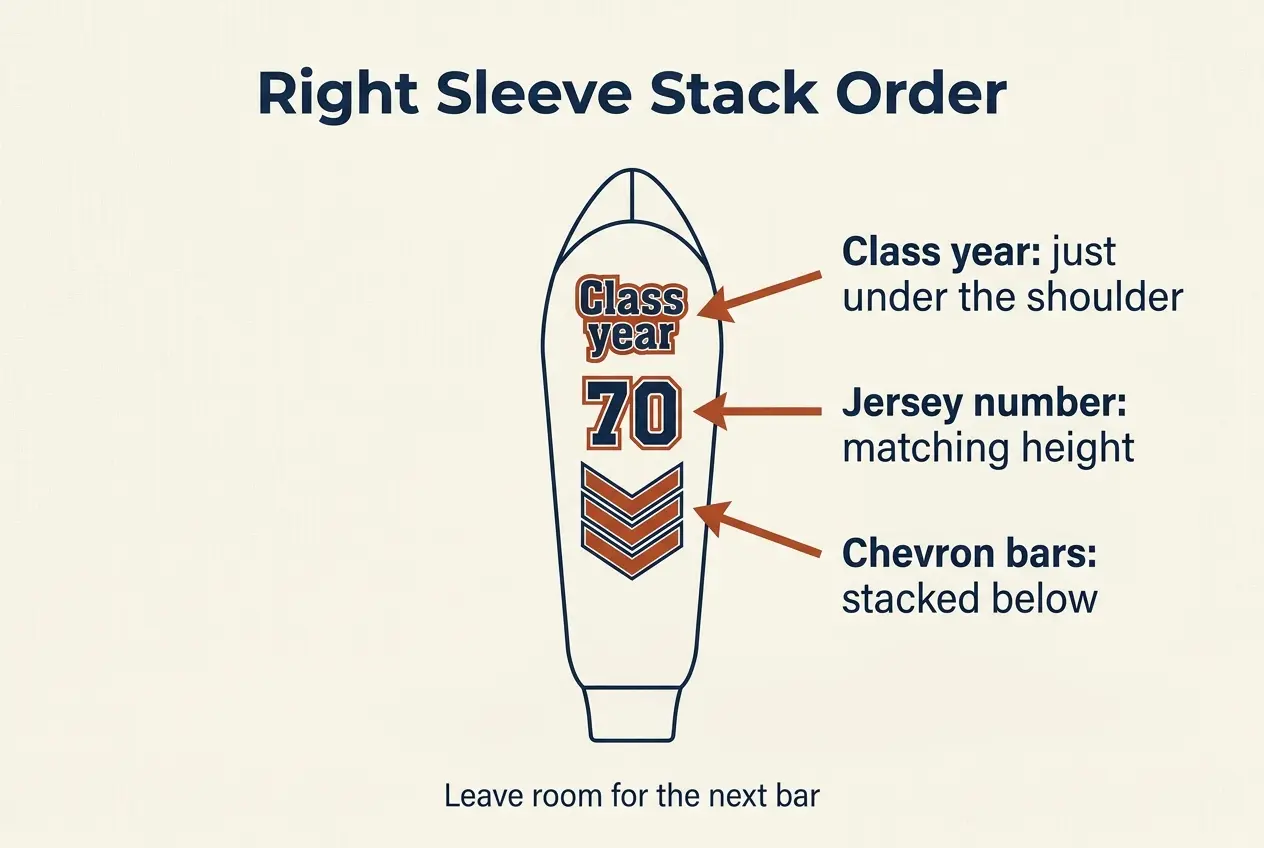
- Mark the shoulder seam.
- Place the class year just below it.
- Set the number at matching height.
- Stack chevron bars below, evenly spaced.
Letterman Jacket Chevrons: What Each Bar Can Count
A chevron is a V shaped bar. Schools use it to mark time or earned status.
- One bar per year
- Common reading. Freshman gets one, senior gets four.
- One bar per achievement
- Some schools count awards, not years.
- Point direction
- Usually point up. Confirm the rule first.
- Ask what each bar stands for
- Ask how many a student may add
- Ask which sleeve is approved
| Stack | Order from the top |
|---|---|
| Common stack | Year, number, then chevron bars |
| Lower stack | Year near the shoulder, bars near the cuff |
| Mixed stack | Number first, then year, then bars |
Guides disagree on exact order. Pick one stack and stay consistent. Share it with us on your layout.
- Use a card as an equal spacer
- Mark each bar with a chalk dot
- Keep bars inside the sleeve width
LEFT SLEEVE
Left Sleeve: Sport Patches and Overflow Space
The left sleeve is the sport side. Letterman jacket sleeve patches here show the sports and activities behind the letter. Overflow from the right sleeve can land here too.
| Patch | Typical spot | Tip |
|---|---|---|
| Sport patch | Upper left sleeve | One per sport |
| Activity patch | Below the sport patch | Band, theater, club |
| Overflow patch | Lower left sleeve | Match the right side |
| Championship patch | Near the shoulder | Keep it small |
- Group patches in a single column
- Keep the same gap between each
- Put the biggest patch on top
- Stop before the elbow bends
Mirror the right sleeve only if you like symmetry. Many jackets stay uneven on purpose.
Guides disagree about which sleeve holds what. Some put sport patches on the left. Others put them on the right.
| Convention | Left sleeve | Right sleeve |
|---|---|---|
| Convention A | Sport patches | Year, number, bars |
| Convention B | Academic, activity | Sports, music, theater |
- New patches land here each season
- Leave a gap for next year
- Keep one patch per sport
Left sleeve space fills up over four years. Plan the gaps now.
CAPTAIN
Captain Patch for Letterman Jacket: Star, C or Bar
A varsity jacket captain patch has no single home. Some teams use a star. Others use a letter C or a short bar. Most go on a sleeve.
| Style | Common spot | Reads as |
|---|---|---|
| Star | Upper sleeve | Leader of the team |
| Letter C | Near the sport patch | Captain by title |
| Short bar | Below the letter | Season marker |
| Name tag | Right front | Role and name |
- Ask your coach where it belongs
- Keep it smaller than the letter
- Sew it near the sport it marks
- Ask the coach what the patch means.
- Ask if it is for one season or longer.
- Pick a spot that fits the stack.
A captain mark is a small badge of trust. Keep it clean and readable.
- Do not crowd it next to chevrons
- Keep one style for all captains
- Order a proof with two spot options
| Spot | Plus | Minus |
|---|---|---|
| Sleeve | Visible, uncrowded | Competes with sport patch |
| Near the letter | Strong and clear | Crowds the chest |
| Right front | Pairs with the name | Competes with academic letter |
Pick the spot that crowds the least. Clean beats clever.
Not every school allows a captain mark. Ask before you plan one. Some programs hand them out with the season roster.
- Ask if the patch is team issued
- Ask if you may order your own
- Ask which style they approve
THE BACK
Back Patches for Letterman Jackets: Mascot, Team and Year
The back is the open canvas. Large patches here show the mascot and team name. Guides often point to 8 inches or more for a back patch.
The back gives the strongest visual identity from a distance. Scale up the patch. A small patch on a big back looks lost.
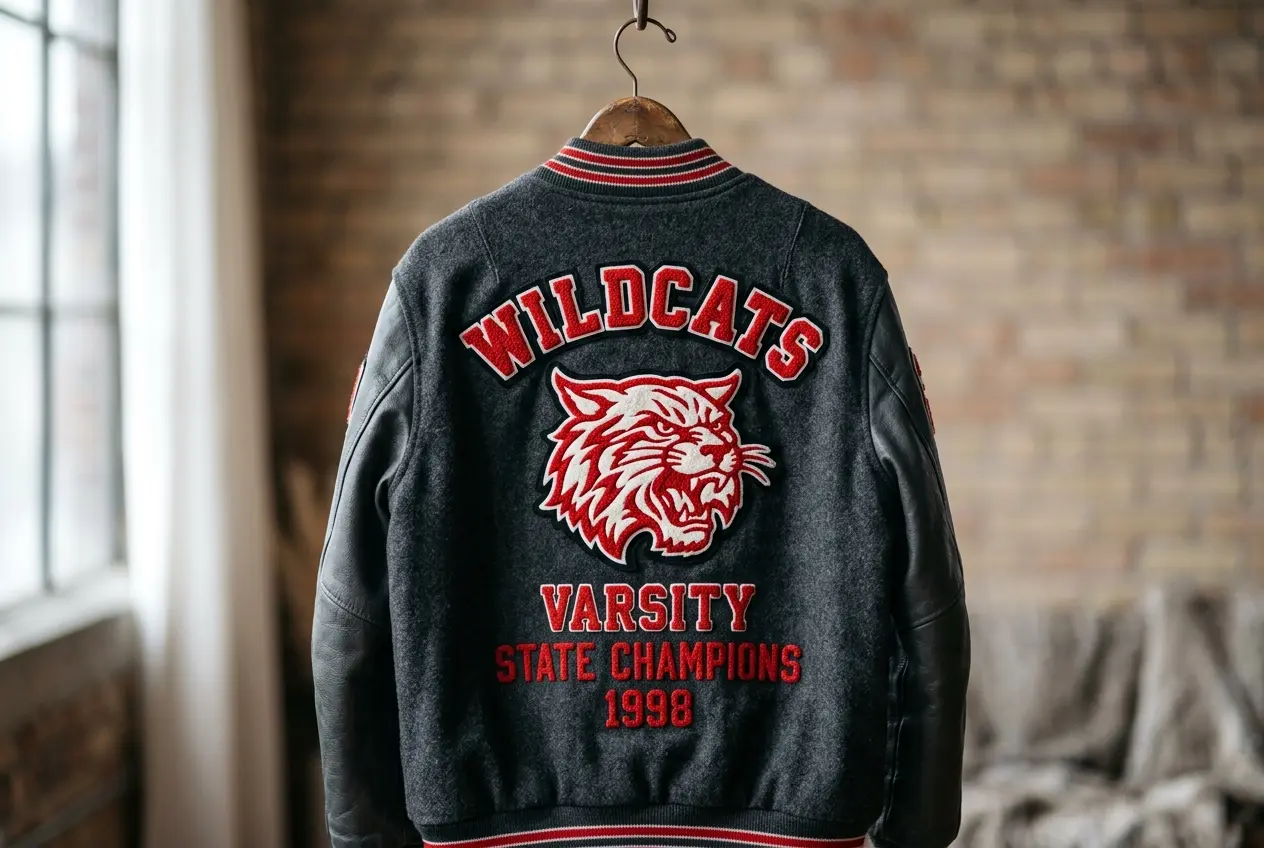
| Back patch | Typical spot | Tip |
|---|---|---|
| Mascot | Center, high | Largest patch |
| Team name | Below the mascot | Curved or straight |
| Year | Lower back | Small and tidy |
| Activity patch | Beside the mascot | Keep the center clear |
- Center on the spine, not the zipper
- Leave a gap under the collar
- Keep clear of side seams
- Add the year last
Back designs are seen from far away. Bold shapes read best. Keep the layout simple.
One bold shape. The cleanest back.
Name arched above or straight below.
A big band or club mark in place of the mascot.
- Check the patch is centered
- Check the collar gap
- Check both shoulder gaps
- Check it sits level on a hanger
Hang the jacket and look from behind. Back problems show up fast.
Back patches carry the most thread. Weight adds up. Sew-on attachment holds best on large chenille, and our sewing guide explains it.
SPACING
Spacing and Proportion: Keep the Letter the Largest Patch
Good varsity jacket patch placement follows a hierarchy. The letter is biggest. Everything else steps down in size.
| Rank | Patch | Relative size |
|---|---|---|
| 1 | Main letter | Largest on the front |
| 2 | Back mascot | Largest overall |
| 3 | Name and academic letter | Small to medium |
| 4 | Sport patches | Small |
| 5 | Year, chevrons, captain | Smallest |
Balance beats symmetry. A large patch on one side can match two small patches on the other. Judge by weight, not by count.
Pros
- Equal gaps between patches
- Aligned edges in each column
- Clear space around the letter
- Patches sized by rank
Limits
- Patches crossing seams
- Patches over snaps or underarms
- Mixed gaps, crooked rows
- Letter crowded by pins
- Stay clear of the underarm
- Stay clear of the snap closure
- Avoid the elbow bend
- Keep patches off the hem
- Leave a gap at each seam
- Focal point
- The one patch that draws the eye first.
- Visual weight
- How heavy a patch looks on the cloth.
- Baseline
- The shared line a row of patches sits on.
- Margin
- The empty gap kept around each patch.
Too many styles on one jacket feel messy. Limit the mix of patch types. Pick a few and repeat them.
Test the hierarchy with a squint. Narrow your eyes at the paper plan. The biggest shapes should stand out first.
- Letter first
- Mascot second
- Everything else follows
Balance the chest and the back too. A big back patch can overpower a small front. Keep the whole jacket in proportion.
MEASURE FIRST
Measure Your Jacket Zone by Zone Before You Pick Sizes
Jackets are cut differently. A narrow cut gives a narrow chest panel. Measure your own jacket before you pick any patch size.
- Lay the jacket flat on a table.
- Measure the left chest panel width and height.
- Measure the right front, from the snap line to the seam.
- Measure the sleeve from the shoulder seam to the cuff.
- Measure the back between the side seams.
| Zone | Measure | Why it matters |
|---|---|---|
| Left chest | Width and height | Sets the letter size |
| Right front | Snap line to seam | Limits name length |
| Sleeve | Shoulder to cuff | Sets stack length |
| Back | Seam to seam | Sets mascot size |
| Collar gap | Collar to patch top | Stops crowding |
Write each number down. Then subtract a margin on every edge. The leftover space is your real patch zone.
- Measure twice before ordering
- Note the snap line on the right front
- Record sleeve length for both arms
- Photograph the jacket flat
Use a soft tape on cloth. A steel ruler sits wrong on curved panels.
- Round to the nearest half inch
- Record the jacket size too
- Add notes about snaps and pockets
PLAN FLAT
Plan the Layout Flat Before You Sew a Single Stitch
Plan on paper first. It costs nothing. A flat plan shows where to put patches on letterman jacket sleeves. It does so before any stitching starts.
Pre-applied elements may already sit on the jacket. Plan around them. Do not remove them to fit a layout.
- Cut paper templates
Trace each patch size onto paper.
- Pin them on
Place templates on the jacket where each patch will go.
- Check the gaps
Measure spacing with a tape.
- Take a photo
Look at it from three feet away.
- Mark and sew
Mark the corners with chalk, then attach.
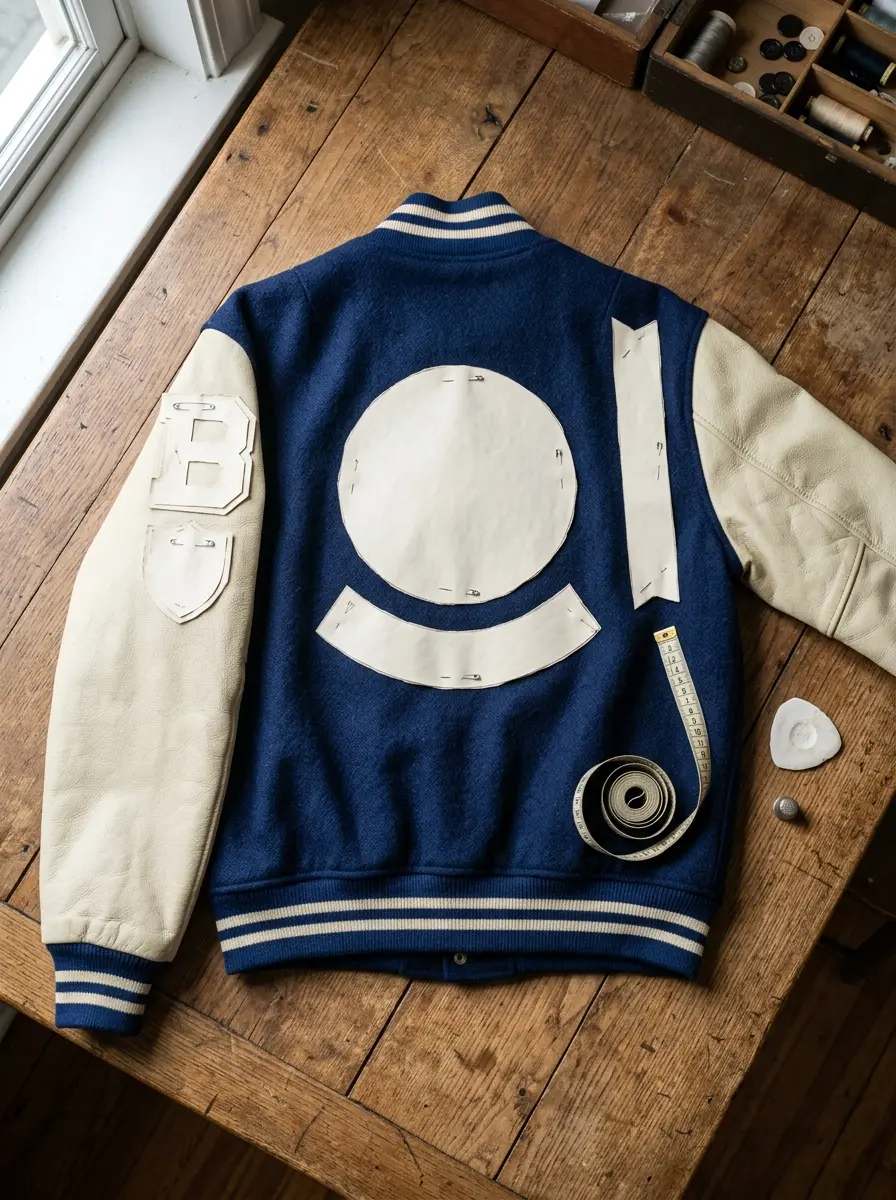
Final letterman jacket patch placement is easier with a photo. You can compare it to the proof. Sewing steps live in our sewing guide. Heat steps live in the ironing steps.
- Paper and scissors
- Straight pins
- A tape measure
- Chalk
- A phone for photos
- Is the letter the largest front patch?
- Are the gaps equal?
- Are the rows level?
- Does any patch cross a seam?
Answer each question from the photo. Fix anything that fails.
FOUR YEARS
Four Years of Building: A Freshman to Senior Layout Path
Most jackets grow over time. Plan the whole path at the start. Then early patches never block later ones.
Your letterman jacket patches arrive in stages. Leave room for each stage.
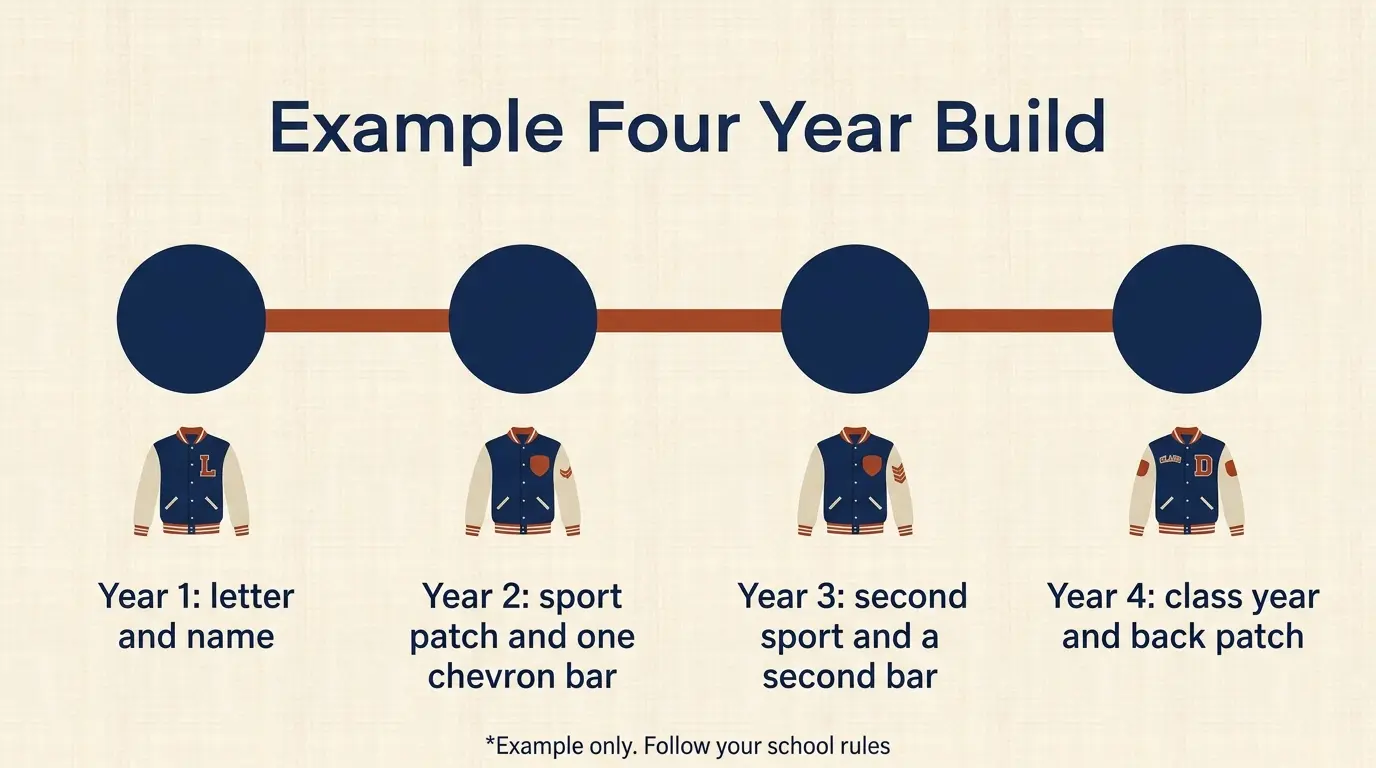
| Year | Add | Leave room for |
|---|---|---|
| Freshman | Letter, name | Sport patch |
| Sophomore | Sport patch, one bar | Second bar |
| Junior | Second sport, bars | Class year |
| Senior | Year, back patch | Nothing else |
- Plan the back last
- Reserve sleeve space early
- Order matching colors each year
Place the letter and the name. Keep sleeves empty.
Add a sport patch and the first chevron bar.
Add a second sport patch or an activity patch.
Add the class year and the back patch.
Buy matching thread colors each year. Dye lots can differ from season to season.
Leave a plan note in your phone. Write which spots are filled and which are free.
- Mark filled spots in one color
- Mark free spots in another
- Update after each season
AVOID THESE
Placement Mistakes and Quick Fixes
Most placement mistakes come from skipping the plan. Each has a simple fix.
| Mistake | What happens | Fix |
|---|---|---|
| Crowded letter | Chest looks busy | Move pins and extras away |
| Patch over a snap | Placket will not close | Shift the patch clear |
| Crossing a seam | Edge lifts and wears | Keep patches inside panels |
| Crooked rows | Layout looks messy | Use a tape and chalk line |
| Tiny back patch | Back looks empty | Scale up the patch |
| Mixed gaps | Stack looks uneven | Set one gap for all |
- Re-check the plan from three feet away
- Photograph before you sew
- Fix the paper plan, not the jacket
- Ask a friend for a second opinion
A fix on paper takes a minute. A fix on the jacket takes a seam ripper.
- Overcrowding
- Too many patches in too little space.
- Drift
- Rows that slowly lean off the line.
- Seam crossing
- A patch that bridges two panels.
Bring a friend for the final look. A second pair of eyes catches tilt and crowding fast.
ORDER PREP
What to Send When You Order Placement-Ready Chenille
Bring the layout to your order. Then the proof matches your plan. Tell us the zone for every patch.
List the letters for letterman jacket use in the order you want them. Add the exact spelling. Our chenille letter and patch options cover the build details. Good letterman jacket patches placement starts with clear data.
- Exact spelling of every word
- Patch size for each zone
- Colors for felt, yarn and thread
- A photo of the jacket with zones marked
- Which side each patch goes on
- How many of each you need
- Artwork file if you have one
| Send | Why it helps |
|---|---|
| Zone list | Matches size to spot |
| Paper templates | Checks size at actual scale |
| Jacket photo | Shows fabric and color |
- Send your layout and spelling.
- Review the free digital proof.
- Request free revisions until it fits.
- Mark zones on the photo with arrows
- Write each patch name by its zone
- List any pins you will add
- Note the jacket brand and color
READY TO ORDER
Send Your Jacket Layout for a Free Proof
Upload Artwork
Send any common file format.
Approve Your Proof
Free digital proof within 24 hours.
We Ship Worldwide
Standard 10 to 14 business days. Rush in 5.
Send your layout and spelling. We return a free proof.
No minimum. Free proof in 24 hours. Ships to 50+ countries.
COMMON QUESTIONS
Letterman Jacket Placement Questions
Which side of a letterman jacket does the letter go on?
The letter usually goes on the left chest, over the heart. Some schools use another spot. Check your school rules and your coach before you sew anything.
Where does the graduation year patch go on a letterman jacket?
Often the right sleeve, just under the shoulder. Some jackets use the right chest instead. Your school may set the spot, so ask first and confirm in writing.
Which sleeve do chevrons go on?
Often the right sleeve, below the year and number. Some guides place them lower on the sleeve, and a few use the left. Confirm the rule with your school.
How many chevrons go on a letterman jacket?
Often one per year, so up to four. Some schools count achievements instead of years. Ask what each bar stands for before you order any.
Where do you put a captain patch on a varsity jacket?
There is no single rule. Many teams use a sleeve, near the sport patch. Show your coach two spots on the proof and let the team pick one.
What goes on the back of a letterman jacket?
Large patches. Think mascot, team name and big activity patches. Center them between the shoulder blades. Add a small class year if space allows.
Should the name patch go on the left or right front?
Often the right front, across from the second snap. The academic letter then sits just below it. The left chest stays for the main letter.
How far should patches sit from the snaps?
Leave a clear gap so the placket opens freely. Pin the patch first, then test the snap before you sew. A tight fit will bend the edge.
Where do patches go on a letterman jacket if the sleeves are leather?
The zones stay the same. Sewing is the most dependable attachment on leather sleeves. Plan your stitch lines flat before you start, and use tape instead of pins.
Do both sleeves need matching patches?
No. Many jackets are uneven on purpose. Balance by visual weight, not by mirror images. One large patch can match two small ones.
How many patches fit on one letterman jacket sleeve?
It depends on patch size and arm length. Lay paper templates in a column on the sleeve. Stop when it feels crowded and keep equal gaps.
Can I plan my layout before the patches arrive?
Yes. Cut paper templates from the proof sizes. Pin them on the jacket and photograph the result. Then adjust the spacing before the patches arrive.
How do I measure a letterman jacket for patch sizes?
Lay the jacket flat. Measure each zone with a tape, then subtract a margin on every edge. Write the numbers down and send them with your order.
Do women's letterman jackets use the same patch zones?
Usually yes. The cut is narrower, so chest and sleeve panels may be smaller. Measure first and size patches to fit your jacket.
What is the most common placement mistake?
Crowding the letter. Too many pins and patches beside it weaken the whole layout. Keep the left chest simple and move extras to the sleeves.
What should I send with a letterman jacket patch order?
Exact spelling, sizes, colors and a jacket photo with zones marked. We return a free digital proof in 24 hours. Revisions are free until it fits.
KEEP EXPLORING