How Do You Remove Iron On Patches Without Damaging the Fabric
Heat, peel and lift the glue. Then wash patched clothes the right way.
Asking "how do I remove iron on patches"? Reheat the glue. Peel while warm. Lift the residue with heat and a mild solvent.
IDENTIFY IT
Which Type of Patch Is It? Iron-On, Sewn, Glued or Hook-and-Loop
Removal depends on the attachment. Check the back and the edges first. Then pick your method.
Pulling a cold iron-on patch tears fabric. Cutting the wrong stitches scars the patch. A minute of checking saves the garment.
| Type | How to spot it | Removal method |
|---|---|---|
| Iron-on | Smooth, shiny backing | Reheat, then peel |
| Sewn | Stitches around the edge | Cut the stitches |
| Glued | Stiff edge, hard glue line | Soften, then peel |
| Hook-and-loop | Rough panel on garment | Pull apart |
| Adhesive-backed | Peel-and-stick edge | Warm, then peel |
- Flip the garment inside out.
- Look for thread through the fabric.
- Feel the edge for hard glue.
- Test one corner with a fingernail.
Not sure which type you have? Test one corner gently first. Never pull hard.
HOUSEHOLD IRON
How to Remove Iron On Patch Residue-Free With a Household Iron
How to take off an iron on patch? Start with heat. The glue softens, and the patch lets go.
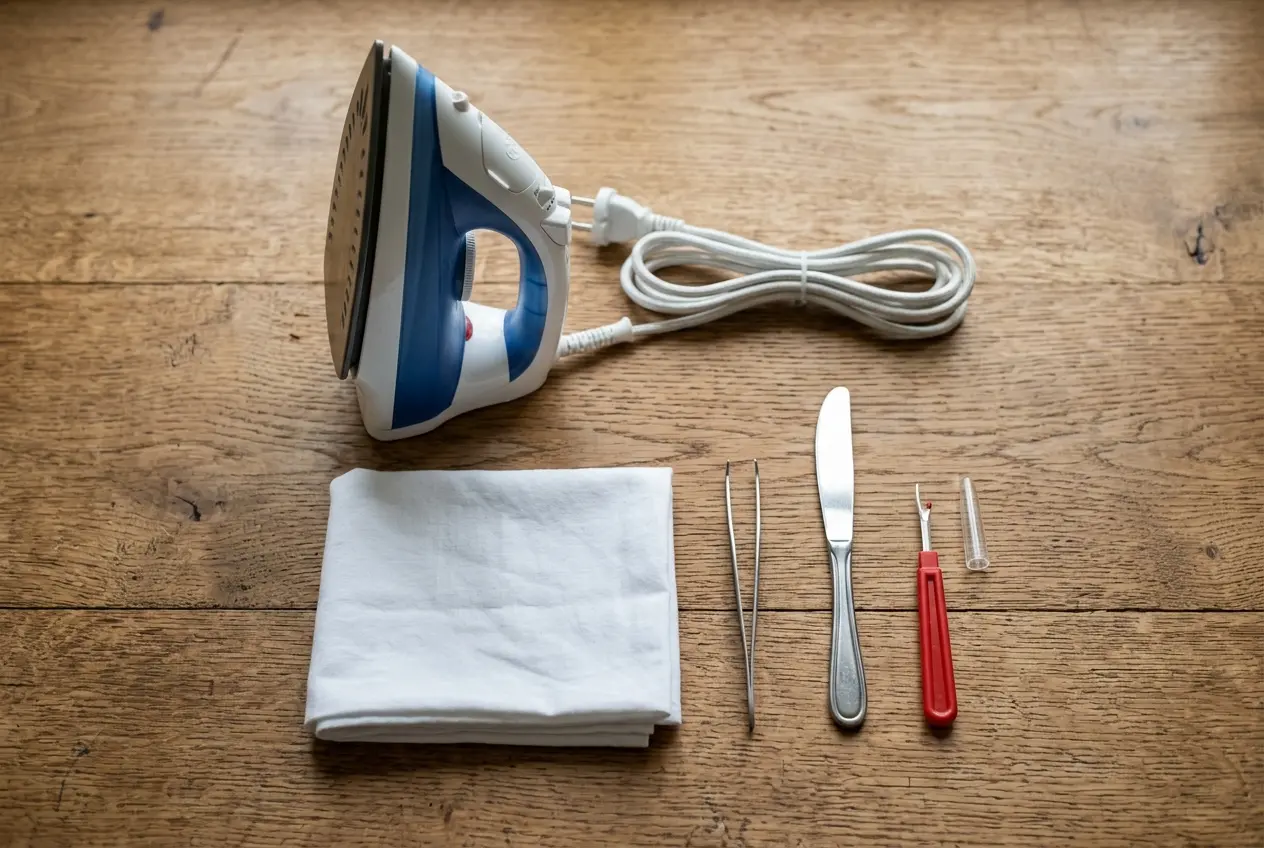
- Gather tools
Set out an iron, a cloth and tweezers.
- Set the iron
Match the setting to the fabric. Turn steam off.
- Cover the patch
Lay a pressing cloth over it.
- Press
Hold the iron down for 15 to 30 seconds.
- Lift a corner
Slide tweezers under a warm corner.
- Peel
Pull slowly while the glue is soft. Reheat if it resists.
- Cool and check
Let the fabric cool. Look for leftover glue.
Work in small sections on big patches. Reheat any corner that resists. Patience beats force.
Tools: Pressing Cloth, Tweezers, Butter Knife or Credit Card
- Household iron
- Pressing cloth or wax paper
- Tweezers
- Butter knife or credit card
- Oven mitt
- Ironing board
Heat Settings by Fabric: Cotton, Denim, Polyester, Leather
Heat is the whole method. Too little and the patch clings. Too much and the fabric marks.
Settings are named by fabric, not degrees. Check the care label too.
| Fabric | Iron setting | Note |
|---|---|---|
| Cotton | Cotton setting | Always use a cloth |
| Denim | Cotton setting | Thick seams need longer |
| Polyester | Low setting | Scorches easily |
| Nylon | Lowest setting | Melts if too hot |
| Leather | Do not iron | Use gentle warmth only |
Four mistakes cause most damage. Avoid them and removal stays clean.
- Pulling before the glue softens
- Pressing without a cloth
- Using steam
- Ironing over the lining
Hair Dryer Method for Delicate Garments
- Set the dryer to low heat.
- Aim at the patch edge for a minute.
- Lift a corner with tweezers.
- Peel while the glue stays warm.
This takes longer than an iron. It is gentler on thin fabric and hat crowns.
JACKET, HAT, UNIFORM
How to Remove a Patch From a Jacket, Hat or Uniform Without Warping It
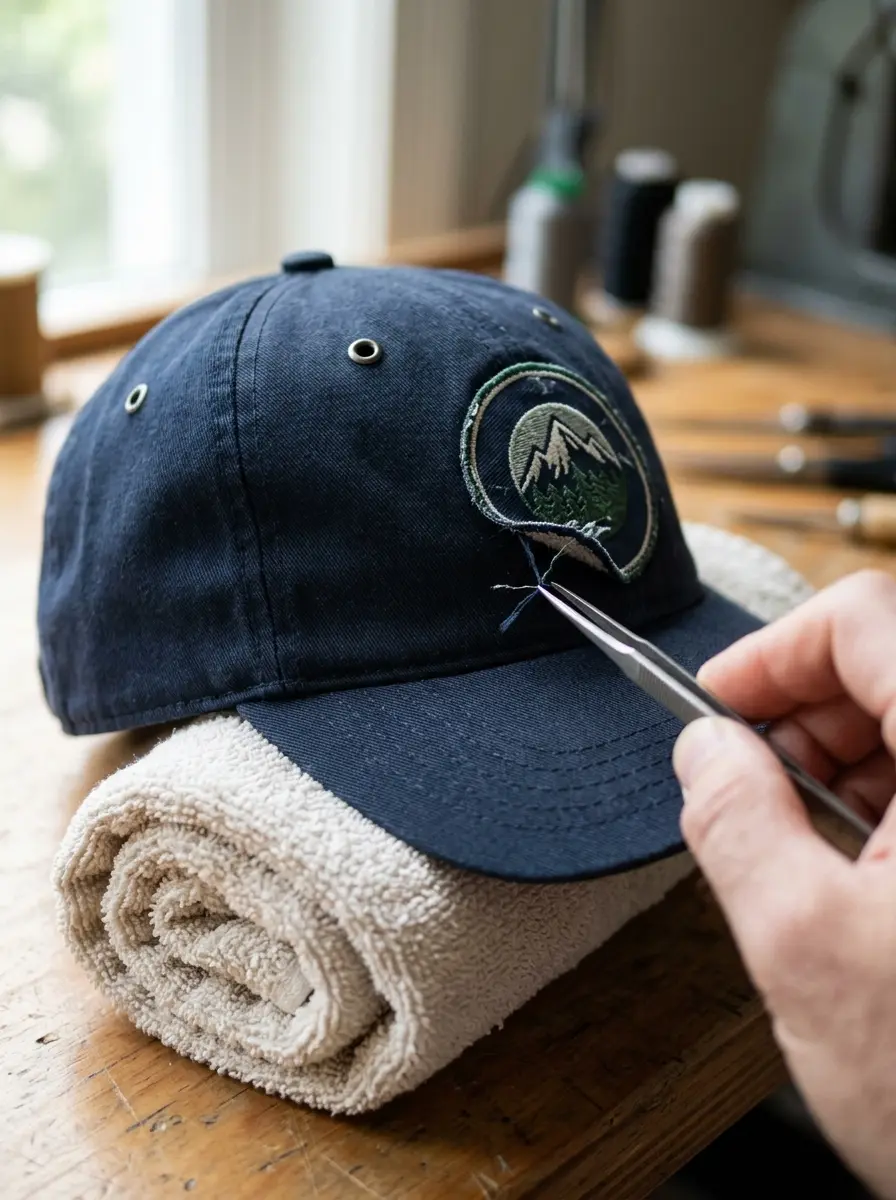
Each garment adds its own risk. Hats have curved brims. Jackets have linings.
| Item | Risk | Tip |
|---|---|---|
| Jacket | Lining can scorch | Slide a folded towel inside |
| Hat | Brim loses its shape | Work over a rolled towel |
| Uniform | Faint outline stays | Wash, then press flat |
Work on the outside, never the inside seam. Hats and jackets mark easily. Slow beats fast here.
- Work from the outside of the garment.
- Never heat the lining.
- Let the fabric cool before checking.
Uniform patches may be sewn and glued. Check both before you pull.
SEWN OR GLUED
How to Remove Patches From Clothes That Are Sewn or Glued On
Sewn and glued patches need different tools. Cut the thread or soften the glue.
Check the stitch type before you cut. Hand whip stitches come out fast. Machine zigzag takes longer.
How to Remove a Sewn-On Patch With a Seam Ripper
- Turn the garment so the stitches show.
- Slide the ripper under one stitch.
- Cut from the garment side, not the patch face.
- Pull the patch away gently.
- Lift loose thread with tweezers or tape.
| Type | Method | Watch for |
|---|---|---|
| Sewn | Seam ripper | Small needle holes |
| Glued | Heat, then peel | Glue left behind |
Needle holes often close after a wash. On leather they stay.
- Cut every second stitch first.
- Pick out the loose thread after.
- Press the fabric flat when done.
GLUE RESIDUE
Getting the Glue Off: Residue Removal in 3 Steps
Residue stays after most removals. It looks like a ghost outline. Work in the order below.
- Heat
Warm the glue with an iron or hair dryer.
- Solvent
Dab a mild solvent on the residue.
- Scrape
Lift the softened glue with a plastic scraper or an old toothbrush.
How to Remove Iron On Patch Glue From Fabric With Alcohol or Remover
| Solvent | Works on | Avoid on |
|---|---|---|
| Rubbing alcohol | Most fabrics | Silk, delicate dyes |
| Adhesive remover | Cotton, denim | Delicates, leather |
| Acetone | Sturdy natural fibers | Synthetics, dyed fabric |
| Citrus remover | Cotton, denim | Silk, leather |
| Dish soap | Light residue | Nothing, but slowest |
Wash the garment after the glue is gone. Keep it out of the dryer until then.
- Use a cotton swab for small spots.
- Blot with solvent, never rub.
- Rinse the area with cool water.
Faint shine can remain on dark fabric. A second wash usually fades it.
REAPPLY OR FIX
Can You Reapply a Patch? Why Patches Peel and the Fix
A removed patch can sometimes go back on once. The glue must still be intact.
Peeling usually points to one cause. Match the sign to the fix below. Most fixes take minutes.
| Cause | Sign | Fix |
|---|---|---|
| Steam | Edges lift | Press with dry heat |
| Low heat | Peels within days | Press longer |
| Short press | Corners curl | Hold the full time |
| Early wash | Loose after laundry | Re-press, then stitch |
- Stitch around the edge for lasting hold.
- Press both sides of the fabric.
- Avoid curved seams when you can.
For full steps, read the iron-on guide and the sewing guide. To choose a method, see the method comparison.
WASH AND CARE
How to Wash Clothes With Patches So They Stay On
Wash patched clothes gently. Heat and friction loosen glue and thread.
Patch type changes the plan. Use the table as your wash label.
| Patch type | Wash | Dry |
|---|---|---|
| Embroidered | Cold, gentle | Air dry |
| Chenille | Hand wash or gentle cold | Air dry flat |
| PVC | Wipe or rinse | Air dry |
| Hook-and-loop | Close loops, wash cold | Air dry |
| Adhesive-backed | Spot clean only | Air dry |
Cold Gentle Cycle, Inside Out, Mesh Bag
- Turn the garment inside out.
- Use a mesh laundry bag.
- Choose cold water.
- Pick the gentle cycle.
- Skip bleach.
Drying: Why Air Drying Beats the Tumble Dryer
- Air dry flat or on a hanger.
- Tumble heat can soften iron-on glue.
Skip the dryer until the patch has settled. Heat and tumbling loosen the edges first.

READY TO ORDER
Need a Replacement? Order One With the Backing You Choose
Upload Artwork
Send any common file format.
Approve Your Proof
Free digital proof within 24 hours.
We Ship Worldwide
Standard 10 to 14 business days. Rush in 5.
Pick your backing, send your artwork and approve a free proof. See the backings page first.
No minimum. Free proof in 24 hours. Rush in 5 business days. Ships to 50+ countries.
COMMON QUESTIONS
Patch Removal and Care Questions, Answered
How do I take an iron-on patch off?
How do I remove an iron on patch? Reheat it for 15 to 30 seconds through a pressing cloth. Lift a corner with tweezers. Peel while warm. Then lift any glue left behind.
What is the easiest way to remove an iron-on patch?
Use a household iron and a pressing cloth. Warm the patch, lift a corner with tweezers, and peel. On delicate garments, use a hair dryer on low heat instead.
Can iron-on adhesive be removed?
Yes. Heat softens it first. Then rubbing alcohol or a fabric-safe remover lifts what is left. Test the solvent on a hidden seam before you treat the visible area.
How can I remove iron-on patch residue?
Follow three steps. Heat the glue, dab on a mild solvent, then scrape gently. Wash afterward. Keep the garment out of the dryer while any residue remains.
Does Dawn dish soap remove adhesive?
It has a mild effect and works slowly. It suits delicate fabrics where stronger solvents are risky. For firm glue, heat plus rubbing alcohol is usually faster.
Will rubbing alcohol remove iron-on vinyl?
Rubbing alcohol lifts adhesive residue on most fabrics. It will not dissolve a vinyl transfer itself. Peel the vinyl with heat first, then treat the glue. Test first.
What dissolves fabric adhesive?
Rubbing alcohol and fabric-safe adhesive removers work on most fabrics. Acetone suits only sturdy natural fibers. Always test a hidden seam, since solvents can strip dye.
Is iron-on patches permanent?
They are semi-permanent. Heat-activated glue holds well at first, but it can loosen with washing and wear. Stitching around the edge makes the hold lasting.
Can I remove a patch without leaving a mark?
Go slowly and keep the heat low. Lift while the glue is warm, then clear the residue. A faint outline may remain, especially on dark or heavily worn fabric.
Can I wash a patched jacket in the machine?
Usually yes. Turn it inside out, use a mesh bag, and choose a cold, gentle cycle. Spot clean waterproof or coated gear instead of machine washing it.
Can a removed iron-on patch go back on?
Sometimes, once, if the adhesive is still intact. Reheat it under a cloth. Stitching around the edge gives a far more lasting fix.
KEEP EXPLORING